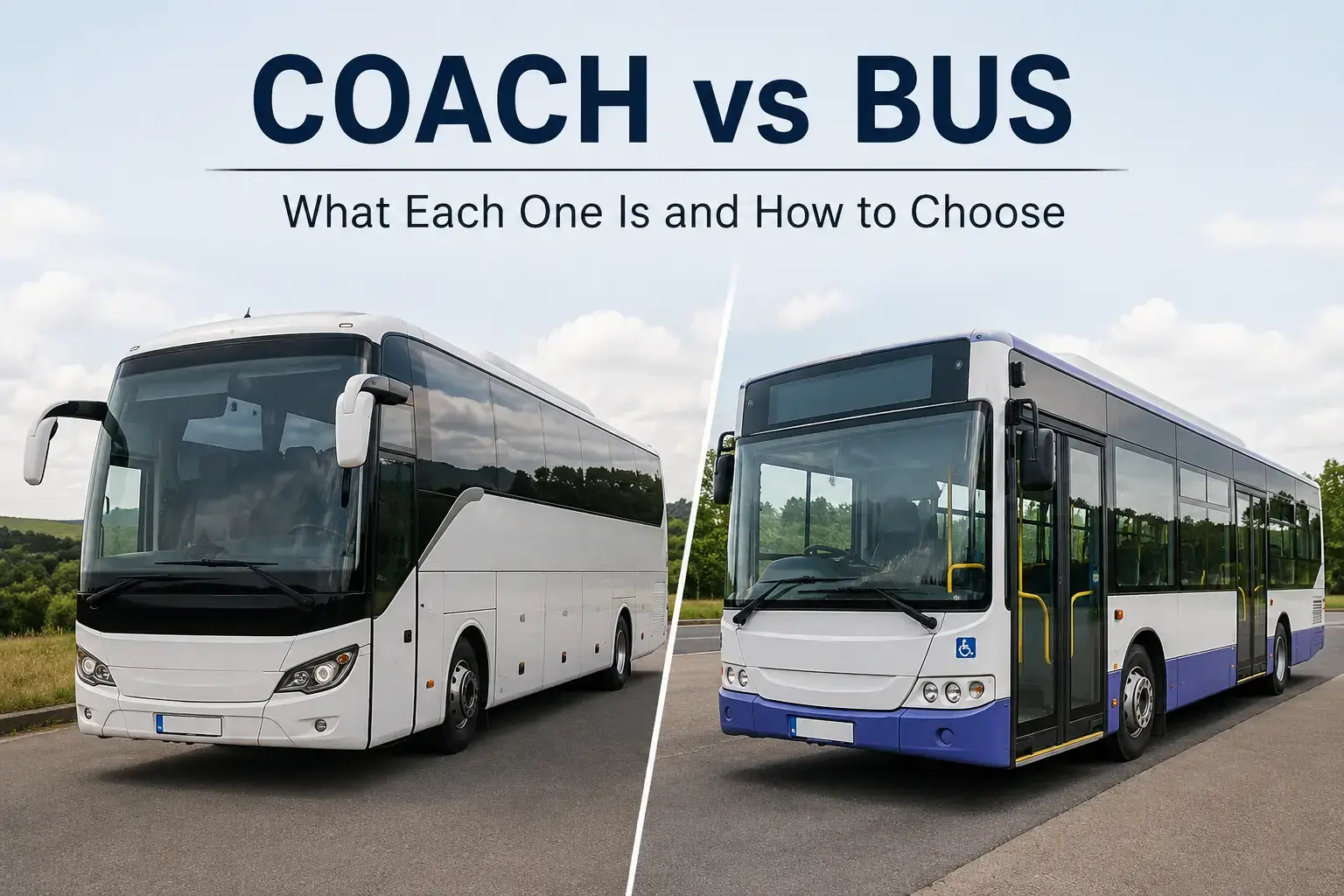
Coach vs Bus: What Each One Is and How to Choose
The coach vs bus choice runs deeper than seats and space.
A coach is a large vehicle built for long trips. It has comfortable seats that recline. It stores bags in a hold under the vehicle. Many coaches also have a toilet and Wi-Fi.
A bus is built for short, local trips. It has low floors and wide doors. People get on and off fast. It often has room to stand as well as sit.
That’s the basic split. The law treats them differently. Drivers follow different rules. Costs and even carbon output work out differently too. This guide covers all of it, in plain terms, so you can pick the right one first time.
Coach vs Bus: What the Law Actually Says
In UK law, a bus on a fixed route with set stops is a “local service.” A coach booked for one group, with no set stops, is “private hire.” This one split shapes almost every other rule below.
Seatbelts: Not the Same Rule for Both
Every coach must have seatbelts fitted. Every passenger aged 14 and over must wear one if it’s there. But some buses are exempt. If a bus only runs on slow, local roads (30mph or under) and allows standing, the law does not require seatbelts on it at all. That’s why a school run or city bus may have no belts, while a coach always will.
Driver Breaks: Why a Coach Trip Needs a Stop
This part rarely gets mentioned, but it affects your timings. Drivers on short bus routes (under 50km) can drive up to 10 hours a day with no fixed break. Drivers on longer coach trips must stop for at least 45 minutes after every 4.5 hours of driving, and it gets logged. So if you book a coach for a long motorway trip, build in a stop. It’s not optional. It’s the law.
Comfort and Build
Coaches sit higher, with a hold underneath for bags. This gives room for soft seats and legroom. Buses sit low, so doors open fast and people move on and off quickly. Neither design is better. Each just does its own job well.
Luggage
A bus gives you space for a small bag on your lap. That’s fine for a short ride. A coach has a hold built for a full group’s cases, kit bags, or gear. If your group has more than a small bag each, book a coach. Otherwise, bags end up stuck in the aisle.
Access for Wheelchair Users: Ask Before You Book
Buses and coaches used on set routes must have a ramp or lift and a wheelchair space, by law, once they carry more than 22 people. But a coach booked for private hire falls outside that rule. It is not automatically wheelchair-friendly just because you’re paying for it. If anyone in your group uses a wheelchair, ask your operator to confirm a ramp and proper clamps before the day, in writing.
Which One Costs Less?
Coach and bus hire is priced mostly per vehicle, not per seat. A coach for 12 people costs close to the same as one for 45. So the price per person drops fast as your group fills the seats. This is often why a full coach beats several taxis or cars, even on a short trip.
Which One Is Greener?
People often assume a big vehicle pollutes more. It’s usually the opposite. Government transport data puts coach travel among the lowest-emission ways to travel per person in the UK, often below the average car and close to rail. One engine moves 40 to 50 people, instead of each person driving alone. A full bus on a busy route does well too, though quiet routes with few riders bring that average down.
Coach vs Bus for Your Trip
Sports teams need to arrive together, with kit in one place. A coach does that. A bus can split the group across stops.
School trips usually need a coach once there’s distance, kit, or an overnight stay involved. A short trip across town can still work on a bus.
Work trips almost always call for a coach, even over short distances. People want to arrive fresh, not standing on a bus.
Airport transfers depend on distance and bags. A short hop with hand luggage can work on a bus. Anything with suitcases needs a coach’s hold.
Weddings work best with a coach. Guests arrive together, at the same time, without a line of cars all hunting for parking.
Coach vs Bus: Quick Checklist
How far, and how fast? Short and local: book a bus. Long, or on a motorway: book a coach, and plan for a driver’s rest stop.
What are you bringing? Suitcases or kit bags mean you need a coach’s hold.
Does the group need to stay together, and does anyone need step-free access? Teams, schools, and work groups do better on a coach. If someone uses a wheelchair, confirm access with your operator first.
That’s the real coach vs bus decision. It’s not just softer seats. It’s the law, the driver’s rules, and the costs that decide how your trip runs.
Get in Touch
Not sure whether you need a coach or a minibus for your group? Call 01942 522 322, email olympia@coach-hire.net, or contact us through the website. Tell us your group size, your journey, and any luggage or access needs. We’ll get back to you with the right vehicle and a clear price.
We’re in Wigan and Bolton and run accessible coach hire across the North West, including Warrington and the surrounding area. Our fleet page has more on the vehicles we operate.
Olympia Travel has helped groups travel on time for over 25 years.
